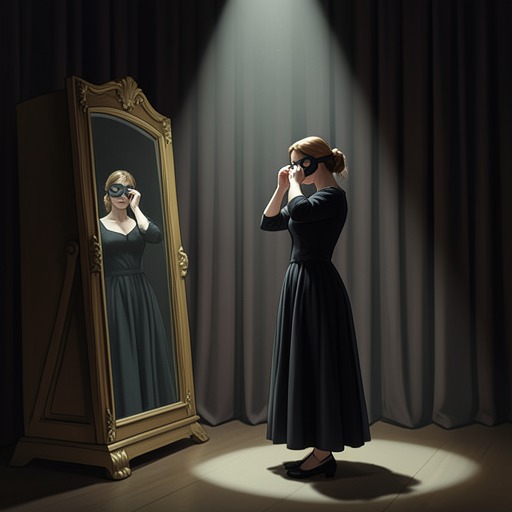
When Night Calls
The Ballad of the Last Dragon“When Night Calls” is a new song by Sylvaine Abelan and one she considers possibly her finest work. First performed publicly after she has shared it only with Kingsley, it transforms private fear into a direct question about whether anyone will remain present when silence and darkness arrive. The performance also becomes an encounter with an unreceptive listener whose physical hostility interrupts Sylvaine’s confidence, making the song both an artistic debut and an act of emotional exposure.
Composition and First Performance
Sylvaine introduces “When Night Calls” as an untested work that she has sung only for Kingsley. Her belief that it may be her best song gives the performance unusual personal stakes: she is not merely filling a tavern set but presenting something newly formed and insufficiently protected by repetition. The song therefore arrives as a concentrated expression of artistic risk, placed before an audience that has not yet become her audience in any meaningful sense.
The performance follows another song that receives three polite rounds of applause. Sylvaine bows in thanks and kicks her cup toward the edge of the stage as a reminder that applause does not itself pay the performer. This practical gesture frames the new song within the material conditions of performance, where creative vulnerability exists alongside the need to secure money and cultivate future admirers. She deliberately looks toward the room because connection with soon-to-be fans matters to her, treating attention as part of the work rather than as a passive response to it.
Lyrics and Emotional Register
The song asks whether someone will answer when night calls, whether quiet will leave the speaker alone, and whether another person can recognize scars and feel the heart beneath closed eyes. Its imagery joins darkness, silence, bodily damage, and intimate perception. The questions are not abstract philosophical inquiries; they test the possibility of being witnessed when ordinary social performance has fallen away.
The lyric’s movement from answering a call, to enduring quiet, to tracing scars and feeling a heart creates a gradual narrowing of distance. It begins with the possibility of response, passes through the fear of isolation, and ends by asking for a form of recognition that does not depend on sight. In that structure, the song gives voice to an experience the surrounding performance scene cannot easily contain: the desire to be known not as a performer, but as a wounded and feeling person.
Audience Response and Interruption
Sylvaine reads the room as she sings. A woman tilts her head in the posture of intent listening, while men at the bar whisper and occasionally drink. Sylvaine understands that some people listen while occupied with other activities, though she judges that mode of attention less intimate than being wholly present with her. Petey remains asleep at the end of the bar, an unmoved counterpoint to the attentive woman and the distracted drinkers.
The most consequential response comes from the dark-haired, scowling man who refuses to look at Sylvaine. He keeps his sights fixed on the wall, curls his hands into fists on his thighs, and grows visibly darker in expression. His reaction causes Sylvaine to stumble over the next plucking pattern. The song’s central concern—whether another person will answer, see, and feel—therefore meets a deliberately withheld gaze in real time. The performance does not produce a simple triumph of connection: it reveals how quickly the performer’s wish to reach an audience can become bodily vulnerability before rejection or concealed anger.
Recurring Language of Care and Pain
The song’s concern with being seen through darkness resonates with later scenes in which injury must be recognized through bodily signs and direct questions. When Jaromir’s condition deteriorates after venom enters his blood, Cadoc examines his pupils and breathing and warns that his body is shutting down. Later, Jaromir, recovering but still suffering, describes his head as feeling as if his skull is on fire; after Sylvaine is hurt, Jaromir immediately asks whether there is pain. These scenes do not establish that the song directly predicts or explains those events, but they echo its vocabulary of scars, hearts, silence, and the need for another person to remain attentive to physical distress.
That echo gives the song a wider function in the narrative. Its questions become a compact artistic form for the book’s recurring ethics of witnessing: danger is survived not only through skill or medicine, but through someone noticing what the body cannot safely conceal. “When Night Calls” turns that need into song before later scenes make it explicit through diagnosis, rescue, recovery, and care.
Narrative and Thematic Significance
The title’s call-and-answer structure places companionship under pressure. Night represents the period when distraction falls away and fear becomes difficult to disguise; answering it means accepting proximity to another person’s wounds rather than merely applauding the polished surface of a performance. Sylvaine’s new song thus extends her role as an artist who converts private uncertainty into a shared form, even when the audience responds unevenly.
Its first performance also stages a tension between artistic control and emotional exposure. Sylvaine can choose the song, shape its melody, study the listeners, and interpret their attention, but she cannot command the dark-haired man to look at her. Her stumble makes that limit audible. The song’s significance lies precisely in this failure of perfect communication: it offers intimacy, encounters resistance, and continues to ask whether presence is possible when the other person remains silent.